Some people might remember that I have written before about the empty dungeon. For some people that is not a problem. They like the exploration of the dungeon environment to be a resource management challenge. Personally I like the idea of the challenge, but I have been thinking of "compressing" the experience a bit. If nothing else, it's variation. Right?
Ken St. Andre posted this on his blog a while ago. I had opened it in a tab on my browser and did not get around to reading it for real until now. That is a neat idea on how to do the "compressing" of your dungeon.
For those who want the executive summary, the idea is to make each room a index card, shuffle and deal a matrix of cards and those are the levels of your dungeon. Nice idea.
Showing posts with label Dungeon Design. Show all posts
Showing posts with label Dungeon Design. Show all posts
Thursday, December 18, 2014
Monday, October 27, 2014
Old D&D editions and clones - Tunnels & Trolls 1st ed.
Now, some of you might object to that title. Surely T&T is not a clone of D&D, and it surely isn't an old D&D edition!? No, it is not, but it is the first published game inspired by D&D and it fits right in here in the series about how much the old games inspire and engage today.
Those of you who have read or played later editions of T&T should really take a peek at this edition if you get the opportunity! I own the 2013 reprint, which might be available yet. I do not know. Anyway. What's interesting about this game are two things, how it differs from later T&T editions and how it differs from D&D.
I found it interesting that on the first page you get a short summary of how to run a game as a GM, how to play it as a player and even the point of sitting around the table talking get across well. I like it a lot. This little section is actually a fairly good primer of what it's all about. Fun details is that the caller is mentioned, as the "Voicer".
There are many fun small idiosyncrasies in this game, but most of it is in the presentation that is extremely colloquial. Ken even jokes about the illustrations right beside the current paragraph. The rules are fairly easy and smooth and there are not multiple odd subsystems.
I like some of the advice for how to run the game, like the emphasize on house ruling, "this is not my game". It is a hack of another game that grew into its own and it is paying its dues. Then there's the suggestion to put in lot of stuff in the dungeons, since "Nobody likes to mess around in a dull dungeon". Here I think Ken is onto something. The big empty dungeon is something I feel have been overvalued in the OSR conversations. I'm not so sure it was a regular feature of the Old Ways even. Ken goes on with some other good advice suggesting that all the threats in the dungeon should be avoidable or be possible to nullify by smart players.
Much of the rules is as you'd expect, with the suggestion you start with a horisontal cut away fo your multi level dungeon, and there are rules for reaction rolls and capturing monsters. I also love the fact that there are names to the character levels. A Veteran is someone who has reached 3rd level, by the way. Not first.
Comparing this to modern versions of T&T and there are some differences. Armour is ablative, Saving Rolls are mainly done on Luck and you get XP for gold and deepest dungeon level penetrated.
I would actually gladly pick up those for all editions, liking them a lot. In general, I like this edition a lot. Expanding Saving Rolls into the "meta mechanic" it got later on and I feel you've almost hit the sweet spot for T&T rules. There's a rawness to the rules, but it's brimming with enthusiasm and small snippets of the life in the Phoenix campaign, like how they all have 3-15 characters per player! For me the rules feels like a big smiling invitation to just roll some dice and dive in the deep end. This is another winner. I really want to play this game!
Those of you who have read or played later editions of T&T should really take a peek at this edition if you get the opportunity! I own the 2013 reprint, which might be available yet. I do not know. Anyway. What's interesting about this game are two things, how it differs from later T&T editions and how it differs from D&D.
I found it interesting that on the first page you get a short summary of how to run a game as a GM, how to play it as a player and even the point of sitting around the table talking get across well. I like it a lot. This little section is actually a fairly good primer of what it's all about. Fun details is that the caller is mentioned, as the "Voicer".
There are many fun small idiosyncrasies in this game, but most of it is in the presentation that is extremely colloquial. Ken even jokes about the illustrations right beside the current paragraph. The rules are fairly easy and smooth and there are not multiple odd subsystems.
I like some of the advice for how to run the game, like the emphasize on house ruling, "this is not my game". It is a hack of another game that grew into its own and it is paying its dues. Then there's the suggestion to put in lot of stuff in the dungeons, since "Nobody likes to mess around in a dull dungeon". Here I think Ken is onto something. The big empty dungeon is something I feel have been overvalued in the OSR conversations. I'm not so sure it was a regular feature of the Old Ways even. Ken goes on with some other good advice suggesting that all the threats in the dungeon should be avoidable or be possible to nullify by smart players.
Much of the rules is as you'd expect, with the suggestion you start with a horisontal cut away fo your multi level dungeon, and there are rules for reaction rolls and capturing monsters. I also love the fact that there are names to the character levels. A Veteran is someone who has reached 3rd level, by the way. Not first.
Comparing this to modern versions of T&T and there are some differences. Armour is ablative, Saving Rolls are mainly done on Luck and you get XP for gold and deepest dungeon level penetrated.
I would actually gladly pick up those for all editions, liking them a lot. In general, I like this edition a lot. Expanding Saving Rolls into the "meta mechanic" it got later on and I feel you've almost hit the sweet spot for T&T rules. There's a rawness to the rules, but it's brimming with enthusiasm and small snippets of the life in the Phoenix campaign, like how they all have 3-15 characters per player! For me the rules feels like a big smiling invitation to just roll some dice and dive in the deep end. This is another winner. I really want to play this game!


Friday, January 17, 2014
Empty rooms and slow moving dungeons
You how the players in your game always wakes up when you without hesitation give a name to a NPC, or suddenly mentions the look of a door in the dungeon?
I have been sitting in agony, trying to get a game moving again after I in passing mentioned some details of dungeon room that was in all other respects just empty. Naturally, if there's a description it has to mean something, right?
A suggestion for us all.
If there's one item, smell or oddity in each room, they will have to consider it all.
Should this lead to games where everything is examined for 15 minutes and the players insist on rolling some ability to find the clue, then just drop a piano on them. Yeah, in a dungeon. Go ahead.
I have been sitting in agony, trying to get a game moving again after I in passing mentioned some details of dungeon room that was in all other respects just empty. Naturally, if there's a description it has to mean something, right?
A suggestion for us all.
When describing a room in a dungeon, always mention one thing of dungeon dressing per room.
If there's one item, smell or oddity in each room, they will have to consider it all.
Should this lead to games where everything is examined for 15 minutes and the players insist on rolling some ability to find the clue, then just drop a piano on them. Yeah, in a dungeon. Go ahead.
Saturday, December 14, 2013
Saturday Night thoughts on the sparsely populated dungeon
It's Saturday night, and I feel a Saturday Night Special feeling coming over me.
Some of you might have read my last post on dense Gygaxian dungeons. Given it is Saturday I got to thinking about those places that make the subterranean underworld its flair, and those moments of "sensawunda". Let me quote you from the 5th ed. Tunnels & Trolls rule book.
I love to invent those crystal waterfalls, devious traps, combat encounters with multiple co-operating foes or locales of majestic proportions and awe inspiring weirdness. Putting down corridors of nothing on graph paper is no longer fun.
Sure, I could use a computer to generating it for me, but I would not find it fun to run either. What I would like to have is a way to make those slow moving bits be outsourced to a second GM and then I could step in a run the Saturday Night Specials. Maybe. Is there a way to get it all?
I'm beginning to feel I understand what Ken St. Andre wrote above and how well it applies to me. I don't like a "dull" dungeon. It would be cool, though, if you could just rattle off some twists, turns and empty rooms without bother to have the first part make sense or be ever repeatable (like for backtracking out of the dungeon or repeat visits), and then dive into it. Too bad I like the idea of repeat visits to the dungeon. I would never be able to improvise the same map twice.
If that could be done, I'd be very happy.
Some of you might have read my last post on dense Gygaxian dungeons. Given it is Saturday I got to thinking about those places that make the subterranean underworld its flair, and those moments of "sensawunda". Let me quote you from the 5th ed. Tunnels & Trolls rule book.
"Let your imagination go wild - you can do anything you want because this is your creation. Put in a lot of stuff - nobody likes a dull dungeon. "So, populating your dungeon. I know some people likes the idea of a big underground labyrinth where there are one third empty rooms or something like that. Each to his own. I don't say I don't like to play that way. But, I've come to realize that I'm no longer fond of creating dungeons like that.
I love to invent those crystal waterfalls, devious traps, combat encounters with multiple co-operating foes or locales of majestic proportions and awe inspiring weirdness. Putting down corridors of nothing on graph paper is no longer fun.
Sure, I could use a computer to generating it for me, but I would not find it fun to run either. What I would like to have is a way to make those slow moving bits be outsourced to a second GM and then I could step in a run the Saturday Night Specials. Maybe. Is there a way to get it all?
I'm beginning to feel I understand what Ken St. Andre wrote above and how well it applies to me. I don't like a "dull" dungeon. It would be cool, though, if you could just rattle off some twists, turns and empty rooms without bother to have the first part make sense or be ever repeatable (like for backtracking out of the dungeon or repeat visits), and then dive into it. Too bad I like the idea of repeat visits to the dungeon. I would never be able to improvise the same map twice.
If that could be done, I'd be very happy.
Monday, December 2, 2013
Different Old Schools - dense or sparse maps
I was listening to a podcast talking about that famous picture of EGG running a game at a con, sitting with a dense map in front of him and a very terse key. I think almost every aspect about that map and its implications have been talked about, but some of that just now filtered down to me.
If you have a dungeon where there are rooms everywhere, and the map is that dense, there wont be much space for some things. If you look at many published maps in the blogging community of the old ways, they most often don't look like that. We often do maps with variation in room sizes, some oddly shaped ones and some hallways connecting sections of the level. You know the drill. Gary's map is just crammed full of fairly small rooms.
Imagine if you will a section of the level taken over by gnolls. They might have made one room a lair, another treasury and maybe a larder where you can free some captives, useful for stocking up on PC alternatives if death does occur. Did you see what I did there?
If you have rooms that looks like an abandoned throne room, you will have a gnoll lord sitting there. But, if your dungeon is just crammed with small rooms, you probably never get that 'naturalistic' feel. If your dungeon is more labyrinth than anything else, the kind of play we call player skill is something different that I have been thinking about all this time. Sure, it's skill when you take note of resources, map carefully to note when there's a gap in there indicating a hidden room. But, if the layout makes no sense, then exploring and mapping to make sense of what's "down there" wont make sense. At least not they way I thought about it. 'Naturalism' is not about dungeon layout, in Gary's example.
Some years ago I heard about Ken St. Andre's dungeon Gristlegrim, and though it peculiar. Ken had done a bunch of dungeon rooms on index cards, when they players walked around the dungeon he grabbed another room from the pile. I thought it made the idea of a dungeon moot, since you could not map it and you could not "make sense" of it. Now I realize that maybe that was not so different from Gary's densely packed paper of small rooms in a labyrinth. Labyrinths was never fun, in my book. After you wandered around in the coal mine in Zork, and realized you had to drop stuff to make the similar looking room distinguishable I think the labyrinth had served its purpose.
I think I prefer some kind of naturalism to my dungeons, even though I now think Gristlegrim makes more sense. It's probably more like Castle Greyhawk and the Jakallan Underworld than my dungeons are.
If you have a dungeon where there are rooms everywhere, and the map is that dense, there wont be much space for some things. If you look at many published maps in the blogging community of the old ways, they most often don't look like that. We often do maps with variation in room sizes, some oddly shaped ones and some hallways connecting sections of the level. You know the drill. Gary's map is just crammed full of fairly small rooms.
Imagine if you will a section of the level taken over by gnolls. They might have made one room a lair, another treasury and maybe a larder where you can free some captives, useful for stocking up on PC alternatives if death does occur. Did you see what I did there?
If you have rooms that looks like an abandoned throne room, you will have a gnoll lord sitting there. But, if your dungeon is just crammed with small rooms, you probably never get that 'naturalistic' feel. If your dungeon is more labyrinth than anything else, the kind of play we call player skill is something different that I have been thinking about all this time. Sure, it's skill when you take note of resources, map carefully to note when there's a gap in there indicating a hidden room. But, if the layout makes no sense, then exploring and mapping to make sense of what's "down there" wont make sense. At least not they way I thought about it. 'Naturalism' is not about dungeon layout, in Gary's example.
Some years ago I heard about Ken St. Andre's dungeon Gristlegrim, and though it peculiar. Ken had done a bunch of dungeon rooms on index cards, when they players walked around the dungeon he grabbed another room from the pile. I thought it made the idea of a dungeon moot, since you could not map it and you could not "make sense" of it. Now I realize that maybe that was not so different from Gary's densely packed paper of small rooms in a labyrinth. Labyrinths was never fun, in my book. After you wandered around in the coal mine in Zork, and realized you had to drop stuff to make the similar looking room distinguishable I think the labyrinth had served its purpose.
I think I prefer some kind of naturalism to my dungeons, even though I now think Gristlegrim makes more sense. It's probably more like Castle Greyhawk and the Jakallan Underworld than my dungeons are.
Friday, December 28, 2012
Empty dungeons - all except the fun parts?
As some of you might know, there's work going on to produce a 8th edition of Tunnels & Trolls. Naturally, it makes me ponder the qualities T&T have, it's quirks and sparkling facets. I remember how the Trollgod, Ken St Andre, wrote in the former editions about how to approach the game, and how it came to be. One thing I remember from older editions of the game is the suggestion, when designing dungeons, to put a lot of stuff in there. Nobody wants to mess around in a boring dungeon, was the thinking. It ties in to the great debate earlier this autumn about the empty dungeon and the pile of "worthless" treasure.I have talked about it before, and might do it again. Now I have some observations to share of what's boring or fun.
Writing a tent pole dungeon, or a megadungeon, it might make a lot of sense to have sections of the dungeon be quite empty, some to be the highways and some to be Saturday Night Specials. Looking at the Wilderlands, the setting published by Judges Guild, it makes sense. It is basically a big empty dungeon, is it not? Now imagine it all being a vast castle, or a big underground mine and it will look kind of the same. I mean, it's a world in of itself. But, let's for a moment limit the vision to something smaller, which is just one adventure, and not a whole world.
You know what Adventure is, right? Adventure is like real world, except the boring parts are cut out. At least that is a way to describe it I find funny. Approaching it a bit more serious, I find the dungeon design advice which suggest you cram in more stuff there, since nobody want to fool around in an empty dungeon probably belong to that school.
So, then the problem is to identify the "boring parts". I know that for many of us playing these games of adventure, we like to be something bigger and greater than we usually are. But, for some others it's not so focused on the bigger, better and greater part. I have found that for those people it's often a question of exploring a secondary world, that is interesting in itself, as a living real place. Personally I like that aspect. Once I played in a game with a very tantalizing setting, with lot of mysteries and it failed for me. I knew at once when my interest started to wane, because we focused on interpersonal conflicts, and I was more interested in the world we never got to explore.
My hypothesis is that this is related to some sense of "realism". Not in the meaning working like the real world, but working in a consistent way within that world. You hear of a mystery, and you know it's not just some random "oddballness", but there's a rhyme and reason for the thing to exist, and you can find it out.
Then, the boring parts are when you explore a fully realized secondary world, and there's nothing there! You expect there to be rich cultures which behave like they do because of their history. You expect to find artifacts which can be better understood by exploring the ancient history of the fallen empire in the world you are exploring. Empty dungeon rooms can then be something of a let down.
Now imagine someone who does not care much for the secondary world, but cares a lot about for a Saturday night feeling great as the greatest ranger of the North, or the mighty slayer of dragons. Empty dungeon rooms can be something of a let down, reminding you a little bit too much of the cubicle or office space you sat in hours before.
I know, of course, of the argument that proper old school play is as much about resource management as anything else. That being said, I don't think it's the only lesson to be learned from the "old ways" of doing things, and if my "boring parts" are your "fun parts" I actually think that aspect of roleplaying games can be brought forth in other areas, not necessarily related to moving about in space. But, that's a subject for some other day. Today I focused on the psychology of empty rooms, which I don't think was covered during the big brouhaha earlier this year.
Thursday, December 15, 2011
Cool things in first edition
As you might have read, I recently became the proud owner of a copy of the British 1st edition of Tunnels & Trolls. It's virtually identical to the American 2nd edition which should be the same as the first one apart from the cover. At least, that's my understanding. Ken or someone else might tell me I'm wrong, though.
In any case it's a marvellous peek into the culture of gaming back in the olden days, regardless of you play T&T or not.
First it starts with some advice on "Digging the tunnels". Tunnels being the word used instead of Dungeons. Yes, this is a game about dungeons. the rules even say about CON and STR that they are automatically restored to their previous level if and when the character returns to safely to the surface! That's a healing rule for you! These are the general rules (paraphrased somewhat) apart from the suggestion that you create a vertical cutaway.
1. Let the imagination run wild
2. Put in as much as you can think of. Nobody likes to mess around in a tedious tunnel.
3. Use as much humour as you can.
4. Deeper in the tunnels mean tougher.
5. Traps and spells should be avoidable.
This goes counter to the Empty Rooms Principle, and I'm not sure I disagree. The principle looks good on paper, but will it lead to players zoning out until something fun happens? Maybe sometimes. Some of the other points I just think is worthy of repeating.
Characters then. Some interesting points. Rogues have to change class after level 7! They have to choose to walk the path of the Magic-User (yes, that's the term. I like it) or the Warrior. Interesting. It would be an interesting hack of D&D to really only have two classes, with magic or without and if you mix you sooner or later have to choose.
Naturally there are rules for combat. As someone who have seen some editions come and go know, inflation hits most games. Everything is smaller in this edition. No weapons doing 6d of damage! Some things worthy of note is the small reminder that you can not fight and hold a torch, and yes all monster get double the amount of dice in a fight in darkness. Ouch! Then there's rules for capturing monsters, which brings back memories of OD&D. Subduing dragons, anyone? I like the variant of the Splintering Shields, where the Warrior (only the Warrior) gets to multiply his level with the armor rating, once, before it is destroyed. Interesting.
When it comes to XP, suddenly we see the gold for XP rule! I like that. Also, multiply by level seem to be a popular mechanic in this part of the rules. Combat XP is Monster Rating x dungeon level / level of the victor. XP for saves are also multiplied by your level, and not by the level of the save. Levels, levels. There's even level titles! Yay!
In general there are many rules in here that I think is better than the newer ones. But, the many subtractions, divisions and multiplications feels a bit old. In any case it's clear that level 7 was something to write home about, and a weapon doing more than 2d is cool again.
In any case it's a marvellous peek into the culture of gaming back in the olden days, regardless of you play T&T or not.
First it starts with some advice on "Digging the tunnels". Tunnels being the word used instead of Dungeons. Yes, this is a game about dungeons. the rules even say about CON and STR that they are automatically restored to their previous level if and when the character returns to safely to the surface! That's a healing rule for you! These are the general rules (paraphrased somewhat) apart from the suggestion that you create a vertical cutaway.
1. Let the imagination run wild
2. Put in as much as you can think of. Nobody likes to mess around in a tedious tunnel.
3. Use as much humour as you can.
4. Deeper in the tunnels mean tougher.
5. Traps and spells should be avoidable.
This goes counter to the Empty Rooms Principle, and I'm not sure I disagree. The principle looks good on paper, but will it lead to players zoning out until something fun happens? Maybe sometimes. Some of the other points I just think is worthy of repeating.
Characters then. Some interesting points. Rogues have to change class after level 7! They have to choose to walk the path of the Magic-User (yes, that's the term. I like it) or the Warrior. Interesting. It would be an interesting hack of D&D to really only have two classes, with magic or without and if you mix you sooner or later have to choose.
Naturally there are rules for combat. As someone who have seen some editions come and go know, inflation hits most games. Everything is smaller in this edition. No weapons doing 6d of damage! Some things worthy of note is the small reminder that you can not fight and hold a torch, and yes all monster get double the amount of dice in a fight in darkness. Ouch! Then there's rules for capturing monsters, which brings back memories of OD&D. Subduing dragons, anyone? I like the variant of the Splintering Shields, where the Warrior (only the Warrior) gets to multiply his level with the armor rating, once, before it is destroyed. Interesting.
When it comes to XP, suddenly we see the gold for XP rule! I like that. Also, multiply by level seem to be a popular mechanic in this part of the rules. Combat XP is Monster Rating x dungeon level / level of the victor. XP for saves are also multiplied by your level, and not by the level of the save. Levels, levels. There's even level titles! Yay!
In general there are many rules in here that I think is better than the newer ones. But, the many subtractions, divisions and multiplications feels a bit old. In any case it's clear that level 7 was something to write home about, and a weapon doing more than 2d is cool again.
Friday, October 15, 2010
Dungeon designed by 5 year old
The best way to make sure the hobby survive must be to make sure your offspring is taught the skills early, right?
A few weeks back I took out my notes for my The Dungeon of Voorand in order to check some small detail. My daughter saw the funny drawings daddy had done, and immediately insisted on making her own in that style. She picked the best parts and invented some similar looking on her own.
She loves to draw and paint.
Can you tell which is mine and which is hers?

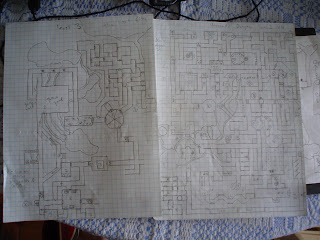
I think it would be so sweet to be able to hand over the reins to her and have her sit behind the screen and have her take us through her dungeon.
Maybe I need to wait a few more years.
A few weeks back I took out my notes for my The Dungeon of Voorand in order to check some small detail. My daughter saw the funny drawings daddy had done, and immediately insisted on making her own in that style. She picked the best parts and invented some similar looking on her own.
She loves to draw and paint.
Can you tell which is mine and which is hers?


I think it would be so sweet to be able to hand over the reins to her and have her sit behind the screen and have her take us through her dungeon.
Maybe I need to wait a few more years.
Wednesday, June 2, 2010
Dungeon Density, again
I recently got hold of two volumes of the Central Casting series of sourcebooks. Some of you might know about these books. Once again it's Paul Jaquays name on the cover. That happens fairly often when I buy game books, for some reasons.
Apart from the ones about fleshing our your character by rolling on a boat load of tables, there's one volume about designing dungeons. Quite interesting considering the qualities Paul have as a dungeon designer, I think.
In the beginning of the Central Casting: Dungeons book, there's a table about dungeon density. I have written about this before, and I think it's worth visiting that subject again in light of what CC:D have to say on the matter.
Looking at the Dungeon Density Table, you will find a lot of different ratings for density. Comparing most of the dungeons published by TSR and other companies, I think they could be classified as "loose-very loose". This is not a scientific verification of everything published, but a general feeling I have. Considering that the densities on the table have a very wide range I wonder why I have gotten that general feeling.
In the megadungeon thread on Dragonsfoot.org forums, many pictures where posted of dungeon maps people had drawn. My impressions of those where that they where pretty dense affairs.
Personally I've found that if I try to fill up every blank area of graph paper, I usually create things which look exciting, but when scrutinized closely they only have one entry point and one exit. Apparently my maps often become linear, and without some empty spaces it's harder for me to detect and remedy that problem. It would be very interesting to hear some input on how different designers handle that.
While I realize this is very much based on my personal impressions of a limited set of data, I still wonder if I'm not onto something.
Why is it that so many published dungeons are fairly "airy", while so many designers at home seem to prefer the dense, involved and convoluted maps? Is this a sign of the tournament dungeon proliferation among published TSR products?
Apart from the ones about fleshing our your character by rolling on a boat load of tables, there's one volume about designing dungeons. Quite interesting considering the qualities Paul have as a dungeon designer, I think.
In the beginning of the Central Casting: Dungeons book, there's a table about dungeon density. I have written about this before, and I think it's worth visiting that subject again in light of what CC:D have to say on the matter.
Looking at the Dungeon Density Table, you will find a lot of different ratings for density. Comparing most of the dungeons published by TSR and other companies, I think they could be classified as "loose-very loose". This is not a scientific verification of everything published, but a general feeling I have. Considering that the densities on the table have a very wide range I wonder why I have gotten that general feeling.
In the megadungeon thread on Dragonsfoot.org forums, many pictures where posted of dungeon maps people had drawn. My impressions of those where that they where pretty dense affairs.
Personally I've found that if I try to fill up every blank area of graph paper, I usually create things which look exciting, but when scrutinized closely they only have one entry point and one exit. Apparently my maps often become linear, and without some empty spaces it's harder for me to detect and remedy that problem. It would be very interesting to hear some input on how different designers handle that.
While I realize this is very much based on my personal impressions of a limited set of data, I still wonder if I'm not onto something.
Why is it that so many published dungeons are fairly "airy", while so many designers at home seem to prefer the dense, involved and convoluted maps? Is this a sign of the tournament dungeon proliferation among published TSR products?
Thursday, April 8, 2010
How to draw dungeons, density and linearity
Taking a look at the very intriguing post by Lord Kilgore at his blog, I was thinking on my latest attempts at drawing dungeons.
I have been drawing while planning, meticulously thinking of how things fit, designing choke points and god knows what. Surprisingly often I feel dissatisfied with the result and never finish them. Very often I draw like crazy and suddenly realize I have made one long corridor with rooms or twists along the line, i.e. a very linear adventure.
So, how much space does people actually have in their dungeons? I have found that if I start by drawing rooms and then try to connect them with corridors, or if I just tries to cram oddities in every open space on the paper I get very different dungeons. I still haven't found a good balance of spontaneity and planning yet. Lord Kilgore's post made me think of that again.
What works? What effect does the "dense" dungeon have in play, and how easy is it to "make sense" of a dungeon like that? Imagine a dungeon like, say, Stonehell, where different dungeon levels have different creatures which live in different sections. Can you make that work in a "dense" dungeon? I find some people draw like that naturally, and I wonder why. Maybe I have something to learn. It looks interesting.
The thing with dense dungeons is that I wonder if it's really that fun to play in such a twisted environment. Mapping it must be quite a challenge, and I wonder how many players are that into mapping.
One of these days I have to just try it out, I guess.
I have been drawing while planning, meticulously thinking of how things fit, designing choke points and god knows what. Surprisingly often I feel dissatisfied with the result and never finish them. Very often I draw like crazy and suddenly realize I have made one long corridor with rooms or twists along the line, i.e. a very linear adventure.
So, how much space does people actually have in their dungeons? I have found that if I start by drawing rooms and then try to connect them with corridors, or if I just tries to cram oddities in every open space on the paper I get very different dungeons. I still haven't found a good balance of spontaneity and planning yet. Lord Kilgore's post made me think of that again.
What works? What effect does the "dense" dungeon have in play, and how easy is it to "make sense" of a dungeon like that? Imagine a dungeon like, say, Stonehell, where different dungeon levels have different creatures which live in different sections. Can you make that work in a "dense" dungeon? I find some people draw like that naturally, and I wonder why. Maybe I have something to learn. It looks interesting.
The thing with dense dungeons is that I wonder if it's really that fun to play in such a twisted environment. Mapping it must be quite a challenge, and I wonder how many players are that into mapping.
One of these days I have to just try it out, I guess.
Monday, December 7, 2009
Designing a new dungeon - Named Areas
I have started a bunch of new projects lately. Anger have caused springs of creativity to spring forth, and now I have a few adventures lined up and maybe even a few more ambitious things.
Since I love the exploration style of adventuring in a big and exciting dungeon I started to plan, design and draw with a megadungeon in mind. Maybe I'll scale it back a bit, or it will have to be something I'll tinker with for a long time.
If you have searched the web for articles on megadungeon design you have probably already found much of the solid advice there is, so I'm not going to try to sound like I have anything new and revolutionary to add. But, I'll write about a nice way to invent a few of those places in a dungeon that stand out and feel a bit special.
Anyone who have read of old school dungeons probably have noticed that there are names areas which makes you wonder what might lurk there. The Black Reservoir is one of those names. Now you can make those yourself! Check out this wonderful blog post with some handy Named Areas charts!
I bet you would love to know what The Gate of the Deadly Harem Slime Ladies or The Mysterious Cave Lagoon of Copper Blood is? Me too. I'm making it up, and sooner or later you might find out. Slime Ladies? Yep.
Since I love the exploration style of adventuring in a big and exciting dungeon I started to plan, design and draw with a megadungeon in mind. Maybe I'll scale it back a bit, or it will have to be something I'll tinker with for a long time.
If you have searched the web for articles on megadungeon design you have probably already found much of the solid advice there is, so I'm not going to try to sound like I have anything new and revolutionary to add. But, I'll write about a nice way to invent a few of those places in a dungeon that stand out and feel a bit special.
Anyone who have read of old school dungeons probably have noticed that there are names areas which makes you wonder what might lurk there. The Black Reservoir is one of those names. Now you can make those yourself! Check out this wonderful blog post with some handy Named Areas charts!
I bet you would love to know what The Gate of the Deadly Harem Slime Ladies or The Mysterious Cave Lagoon of Copper Blood is? Me too. I'm making it up, and sooner or later you might find out. Slime Ladies? Yep.
Thursday, November 19, 2009
How to design and populate your dungeon
I have been thinking of starting a new dungeon. Still I am missing an important thing to get my campaign going again, players. But, just for fun and in order to keep some of the creativity flowing I'm thinking of putting pen to graph paper and digging a new dungeon.
Most of you have probably read some hints on how to write an adventure. You should have a plot, a setting, antagonists maybe a McGuffin and some nice scenery. When designing dungeon adventures it's fairly common to start with the location, the windling tunnels. It makes sense. Without somewhere to explore, there will be no place to put the monsters, treasure, traps and wonders. Right?
Since a couple of days I've had my copy of Dangerous Denizens out of the shelf, thumbing trough it. For those of you who don't know of it, it's the Tellene specific monster manual for 3rd ed Kingdoms of Kalamar. I'm a fan of KoK and have many times felt it would be cool to have a game there, but it haven't happened yet. For some other reasons I've also had my copy of 1st ed Monster Manual out of the shelf a few times to look up monsters other bloggers have been writing about. There are quite a few fairly weird monsters out there for D&D, I tell you.
All of this have gotten me to think of a new way to design a dungeon! Some of these monsters just scream out to be used, or at least some of them makes you wonder "how the hell could I use that one to make sense, at all?" Could be a nice creative exercise, right? It would be fun to hear if somebody tried it out?
So, take out a monster book, pick some really odd stuff and try to figure out how to make that monster fit somewhere, or where it would look cool. I'm going to try it out myself.
Most of you have probably read some hints on how to write an adventure. You should have a plot, a setting, antagonists maybe a McGuffin and some nice scenery. When designing dungeon adventures it's fairly common to start with the location, the windling tunnels. It makes sense. Without somewhere to explore, there will be no place to put the monsters, treasure, traps and wonders. Right?
Since a couple of days I've had my copy of Dangerous Denizens out of the shelf, thumbing trough it. For those of you who don't know of it, it's the Tellene specific monster manual for 3rd ed Kingdoms of Kalamar. I'm a fan of KoK and have many times felt it would be cool to have a game there, but it haven't happened yet. For some other reasons I've also had my copy of 1st ed Monster Manual out of the shelf a few times to look up monsters other bloggers have been writing about. There are quite a few fairly weird monsters out there for D&D, I tell you.
All of this have gotten me to think of a new way to design a dungeon! Some of these monsters just scream out to be used, or at least some of them makes you wonder "how the hell could I use that one to make sense, at all?" Could be a nice creative exercise, right? It would be fun to hear if somebody tried it out?
So, take out a monster book, pick some really odd stuff and try to figure out how to make that monster fit somewhere, or where it would look cool. I'm going to try it out myself.
Saturday, September 5, 2009
I want to see the manager! or "Who runs this dungeon anyway?"
Just a couple of days ago I found my copy of the 5th ed T&T again. Having used 7.5 for my regular gaming needs, it is very interesting to see how this celebrated edition compare. While the editing it far better than the shoddy job Fiery Dragon did, it still has its quirks. Like missing page numbers!
I did find this one gem I wanted to share, about the making of a dungeon (2.5 How to be a GM):
There is also the consideration of a motivating character, a proprietor -- the mastermind who created the complex within the logic of the fantasy world itself (this is frequently an alter-ego of the person who created the dungeon on paper). This alter-ego may provide a "reason" for the presence of the dungeon, and may or may not take any kind of participation in occurrences within the dungeon itself. My own dungeon Gristlegrim is run by an incredibly ancient and learned wizard of the same name; he rarely puts on personal appearances. On the other hand, Liz Danforth has a devilish little fellow who "built" her dungeon as a lure to entice the unwary into situations where they are willing to bargain for their souls; his personal offices can be found in the lowest levels.
I find this very interesting. Somehow the idea has gotten foothold that once in the early days of the hobby it was all wild merriment without rhyme and reason, and then came dungeon ecology and story; chaos had been conquered and now it all Made Sense. In this quote we see that in the Phoenix Circle they had a driving force behind their dungeons, and a reason for them to exist. The history of the early hobby is different from how it is often told.
I expect there will be more of these kind of hidden glimpses of a bygone age as I continue to peruse this volume. For historians of our hobby is this a goldmine. You all know that Flying Buffalo Inc. still sells this edition, right?
But, I think it has value in a more practical sense as well. My dungeon was the Dungeon of Voorand. My players knew him to be the slightly nutty "god" of the goblins, and he had a very real presence by the gaming table, where any kind of oddness could be blamed on "that crazy goblin". My personal stamp was all over the place, and the play on my name made it even more obvious than the fact that I of course was the one who had drawn the dungeon. Do you want to make up a theme for a dungeon? Think about the proprietor and I bet there will be ideas to use at once.
Saturday, June 6, 2009
The Dungeon Alphabet will be published by Goodman Games!
If you're a regular reader of Michael Curtis very entertaining blog The Society of Torch, Pole and Rope, then you know that he has done an alphabetic rundown of all the tropes and elements of dungeons. I think he managed to nail down a lot of the feel of a good dungeon in those entries.
Now Goodman Games have decided to publish the alphabet in a book! Go to the web page for the book, and look at who's involved in addition to Mike. Impressive. Here's the announcment.
Make a note of that one. It will be good. Really good.
Thursday, June 4, 2009
To Craft Dungeon of Voorand part II
I have been thinking a bit about how to make an interesting dungeon again. One thing I really wanted to make a key feature of my campaign, was for it to be player driven. A sue way to snap the suspension of disbelief for me is to have the world "know" the level of the players and only throw "scaled challenges" at them. They key is to have enough open doors to let the players choose what they want to do.
When I look at my dungeon maps I think they are way to limited. If I truly want the players to be able to choose what to explore there has to be a lot of possibilities to move up and down! From now on when I have nothing better to put in, sitting at the graph paper with pencil in hand, I will put in a stairway. How much is good enough? Looking over some old maps, like the maps of Blackmoor castle, you'll see stairways all over the place! Tossing out some numbers I'm thinking that out of ten stairways on a level, at least three should go to the next lower/upper level and four going to stuff way deeper down.
Maybe the key here is for the players to encounter a serious temptation, or choice, to go on deeper at least once a game session. I don't think the density of stairs and the possibilities of movement up and down have been investigated much in the discussions online about dungeon design. It would be interesting to know what people think of this. Please let me know if you have any links to discussions like that.
For now I have been preparing stuff for my players to explore on level two, three, four and five. If that's not enough I don't know what is!
Monday, May 18, 2009
When I entered a real Dungeon
Edit: The paragraphs had been terribly mangled. Now it should be readable again. Sorry about that.
A real dungeon!
A real dungeon!
Many sheets of graph paper have been covered with tunnels, depicting shrines, tombs and other kinds of underground complexes. One very good rationale for underground tunnels is of course mines. Now have I finally been down into a real, dark and muddy mine and thought about sharing some of my impressions. Maybe you have read the Dungeon survival guide that TSR put out for 1st ed, and think that was good enough, or just not the territory you wanted to take your game. I'm not going to try to cover that territory again, instead trying to focus on my feelings and impressions of mines as an environment, which might give some idea what you waht to do with underground complexes in your game as far as general feel is concerned.
The first thing I was thinking about when I stood in a small steel cage that was rushing down into the depths of the earths was how claustrophobic it felt. It was also a very , very quick elevator. I don't think I've ever travelled an elevator at such a breakneck pace before. That will of course be of relevance for a gaming situation. How will you enter the underground? It's probably very far deep down, and that whole in the ground is probably not made for comfort, but for some other purpose (like hauling ore).
When I first stepped out of that metal cage, two things struck me. The noise down there, and the heat. Now, most people thing of the underground as cool and wet. While the latter might be true up to a certain depth, depending on the kind of rock, the fact that a mine actually gets hotter as you go down is maybe not that obvious. If your dungeon is a mine, where people actually dig after ore, I think it might give a better impression of realism if your delvers will find either creatures equipped for handling extremely hot working conditions either by technology or my natural abilities. The mine I visited was ventilated and had cooling equipment, but it was still very hot. The natural ambient temperature was 42 degrees, Celsius! I was told that gold mines in South Africa are as hot as 60 degrees. Murderous environment!
The noise then. In a modern mine there are fans, cooling radiators, ducts of cool and warm air that flows in the tunnels. I have no idea how they did that back in the bad old days, but the wind can, if you end up in the wrong tunnel not only blow you off your feet, but also been scorchingly hot or maybe bring with it dust and sand which will be just as bad as end up in a sandstorm in a desert.
Those hazards brings me to another topic. When I draw dungeons, they very often end up far to regular. I've written about that before, how my dungeons look way to much like the downtown road network of a north American metropolis if I'm not careful. In a mine, or any other kind of underground, there will be hazards galore. Especially if there's monsters fair an foul wandering around. So, there's probably a lot of small niches, dead ends or other short tunnels and alcoves only used for hiding when something nasty comes down the tunnels. Make sure you include some of them in your own dungeons, I sure will do in the future.
I know I've read many times about how classic old school dungeons might have signs or chalk markings left by former delvers or inhabitants. That is also something that was very obviously present in the mine I went down into. If there was a compressor for the air vents, it was labelled. Also, big grey housings for the electricity down there was labelled Danger and “13800 Volts” and similar. “Foul Air, beware” was another one. Apart from signs there was also a lot of chalk markings, mostly numbers and arrows. This of course brings home the fact that many of the signs down below will only make sense for the intended recipient. Some might be general warnings, and other might be very cryptic. Obvious usage of that kind of things is to give players a hint of the friendliness of the inhabitants of an area. Are they expecting traffic, and someone who might need guidance? This is an area where I see intelligent delvers succeeding where foolhardy ones might not. Make sure you see the signs, subtle and obvious, and act accordingly.
A few more things struck me as interesting down there. Since the air, even when the whooshing air fans had brought it down, was a bit stale and it was tiring to walk far when the air was more saturated with CO2 and has less oxygen that usual. Also, the amount of muck and mud down there was amazing. The idea of bringing a spell book down there boggles the mind! It's very dry 6800 feet down, since it's below the ground water, but the dust is there. And when you have water, there's mud everywhere! It might not be fun to consider all the details like humidity, sulphurus air, dust and what effects they have on swords, leather and spell books. But, make sure you tell your delvers that they look like they have been crawling in mud, or that they are dusty and dirty. They might get some of those utility spells that way, and will feel at least a tiny bit more real.
A mine is a very moody setting for adventure, and a very different environment. It's very deadly, very confined, very hot and very mucky. And loud noises everywhere from wind or equipment. It's wrap up with a short atmospheric piece. As I was going along one of the big tunnels, I passed a smaller side passage, and turned my helmet lamp in that direction to see what it was. There it was, a small tunnel, with uneven floor and with very varying height so would have to stoop down to just get through. Far up ahead I saw a fork in the road, where the tunnels moved on, smaller and smaller, and a rusty chain hanging across one of the passages with a sign sayign “Beware” and the rest illegible. A maze or twisty passages, indeed. I went on following the main tunnels.
Friday, May 15, 2009
The One-Page Dungeon Contest ended, and now some self scrutiny
UPDATE! THE DEADLINE IS EXTENDED! New deadline is May 21st at 8:00 AM Eastern Standard Time (US)
The time is up, folks! I was thinking a lot about this contest, and as I was sketching more of the third level of my Dungeon of Voorand, I realized that I probably wouldn't be making it.
Much have been said about dungeon design, and many words of praise have been heaped upon the one-page template. For some it seems to work like a catalyst for the imagination, but apparently not for me. Now, it's not just the 30 x 30 one page limitation that hinders me. Frankly, I think I have understood some of the limitations of my own attitude toward game mastering and crafting adventures.
I began my career behind the screen mostly by chance. We had decided a couple of friends to share game mastering duties, but since I started I kind of got stuck at it. One thing which have struck me as I've read about other people's campaigns, is that the classic campaign which is home grown from character generation and onward, is not really my thing.
While the idea of creating a world is interesting, I have always worked mostly from "canned" adventures and settings. Laziness aside, I think the reason it has worked well for me is because I am fairly good at adapting stuff and wing it, if I have a starting point! I am better at patching together a "story" of adventure and exploration from a pre-packaged adventure and the meanderings and wild goose chases that players let themselves get carried away by, than preparing stuff whole cloth. I'm not creative if I have to be original, but if I get to take all that buzz around in my head from other sources and just throw it all against the wall and see what sticks, I usually pick fairly sticky stuff.
I sat there with a 30 x 30 grid and wondered what I should do. Having started a few chambers and corridors I realized that if I just connected those by 10 feet passages I would have a dungeon that's as good looking at a map of downtown Toronto, or a chessboard. It's obvious that I create my dungeons in a different way. Now I'm getting curious how!
When I think back to how I've done my megadungeon, I've basically taken all the kind of weird shit I've ever read of, and just thrown them together. Dungeon ecology really isn't my thing, since I don't have the ability to focus on more than one room at a time! Maybe it would be a good idea to get some grasp of how ones creativity works. I've read many times of writer's block, and this small contest have given me new insights about how I write and design. Scary, and hopefully useful later on. Maybe it's something worth thinking about for you, dear reader? If you one day sit there with a 30 x 30 grid and don't know what to put down, it might help to know by what process it used to work.
Monday, May 11, 2009
Traps, weal or woe?
We have had some discussion over at ChattyDM about traps. Chatty started to talk about how to judge the one page dungeon contest, and what the difference between the old school and new school is. Soon we started talking about why traps should be interactive.
It struck me that the reason some people think a traps just means "send in the thief, roll some dice and get on with it" are not because they don't like the idea of traps, but that they have encountered situations which conditioned them to that reaction. Maybe that conditioning even turns them off the idea of traps altogether!
As someone who likes traps, and would like to see them used and enjoyed, I think I have to think more about how I deploy them in my own game. I think I will try to put down my philosophy of traps and their usage, and to stretch my wings a bit maybe I can make it accessible for gamers of any editions or game. Maybe it's to bold a project. We'll see.
Lastly, read this amusing narrative of a close encounter!
Subscribe to:
Posts (Atom)


 Posts
Posts

